














































































Tanzania’s exports cross the $20 billion mark
The country’s exports rose by 16.4 percent to $20.22 billion in the year ending August 2026, up from the corresponding period a year earlier, according to the Bank of Tanzania’s (BoT) Monthly Economic Review for August 2026


Dar es Salaam. Tanzania’s exports of goods and services have crossed the $20 billion mark for the first time, buoyed by gold earnings, manufactured goods and resilient receipts from tourism and transport services.
The country’s exports rose by 16.4 percent to $20.22 billion in the year ending August 2026, up from the corresponding period a year earlier, according to the Bank of Tanzania’s (BoT) Monthly Economic Review for August 2026.
The milestone was accompanied by strong performances in merchandise trade, with goods exports surpassing $11 billion and manufactured goods exports exceeding $2 billion for the first time, reflecting the growing contribution of both commodity earnings and industrial products to Tanzania’s external trade.
“Goods exports increased by 19.8 percent to $11.96 billion from $9.98 billion in the year ending August 2025, supported by gold, manufactured goods and improved earnings from traditional exports, including tobacco, tea and cotton, the BoT report reads in part.
Gold is king

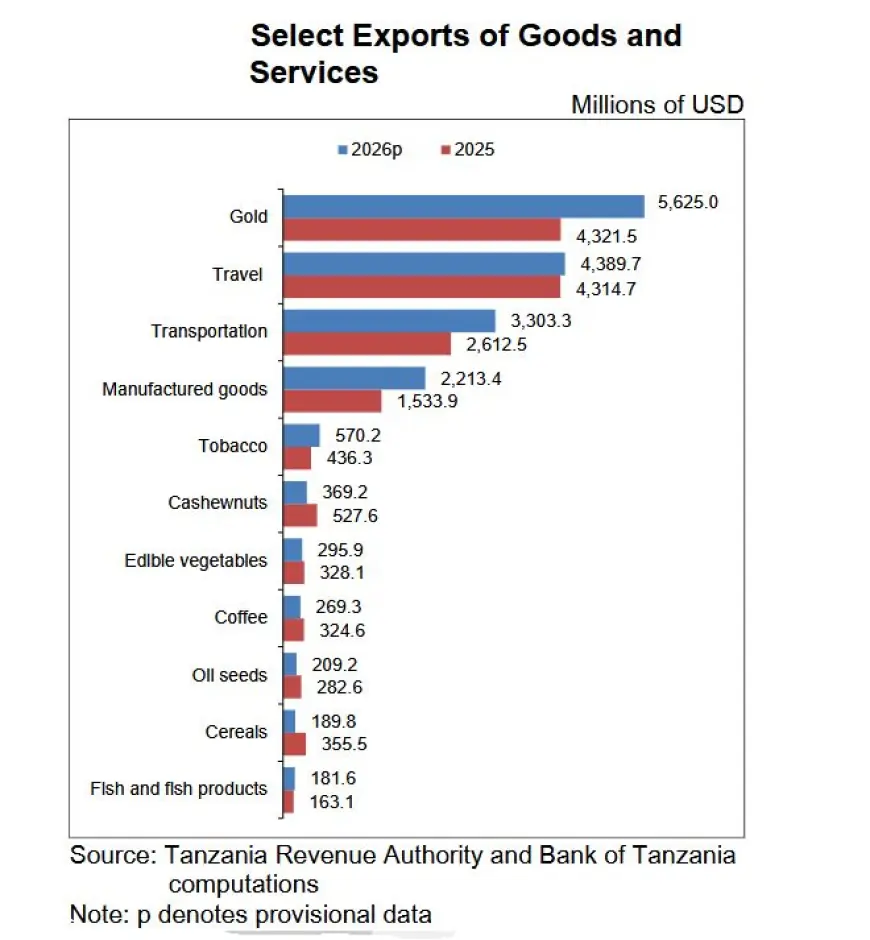
Gold remained the principal driver of growth, with export earnings climbing to $5.63 billion from $4.32 billion.
The increase was attributed to higher international prices and export volumes, with gold accounting for nearly two-thirds of the overall increase in merchandise export earnings.
The performance underscores the mineral’s central role in Tanzania’s export sector and its contribution to foreign exchange generation.
However, the influence of global prices also means that export earnings remain exposed to developments in international commodity markets.
Manufactured goods exports recorded another notable gain, rising to $2.21 billion from $1.53 billion over the period.
The increase was mainly driven by higher exports of iron and steel products and glassware.
Crossing the $2 billion threshold marks an important development for Tanzania’s non-traditional exports, as manufactured products complement primary commodities in generating foreign exchange.
Sustaining this growth will depend on the competitiveness of domestic industries, access to export markets and the capacity to expand production.
Traditional exports also contributed to the expansion, with tobacco, tea and cotton recording gains, further broadening the sources of merchandise export earnings.
Services exports strengthened alongside goods.
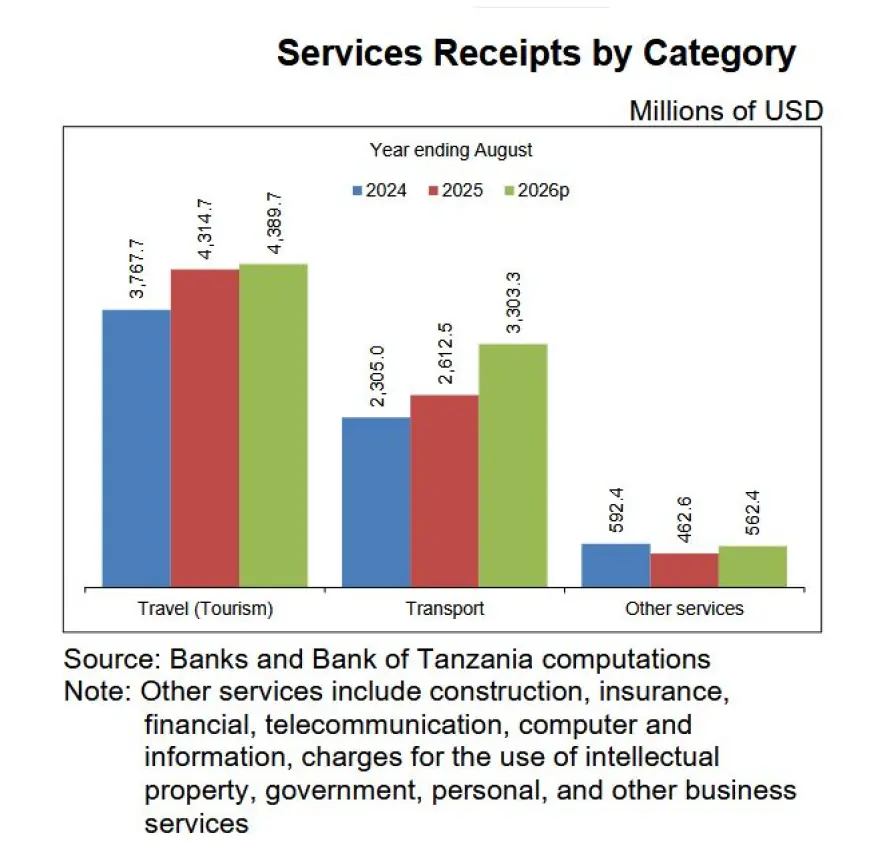
“Receipts increased by 11.7 percent to $8.26 billion from $7.39 billion in the year ending August 2025, supported mainly by transport and travel,” the MER reads in part.

Transport receipts rose to $3.30 billion from $2.61 billion, reflecting higher freight earnings from transit trade.
The growth highlights Tanzania’s role in facilitating regional commerce through its transport corridors and logistics services.
Travel receipts increased to $4.39 billion from $4.31 billion, demonstrating continued resilience in tourism, a key source of foreign exchange for the country.
Widening trade account
Higher costs of petroleum products and intermediate inputs pushed import growth above export growth, the central bank said, widening the trade deficit.
“Consequently, the current account deficit widened to $2.48 billion in the year ending August 2026, from $1.7 billion in the corresponding period of 2025.
Therefore, despite strong performance on the export side, Tanzania’s import bill expanded at a faster pace, rising by 21.4 percent to reach $21.27 billion in the year ending August 2026.
This has widened the gap between exports and imports that was narrowing at a very fast pace.
According to BoT statistics, the gap started closing since 2025 when exports closed the gap from $14.72 billion in August 2024 (against imports of $16.679 billion) to August 2025 when exports were $ 17.37 billion (against imports of $ 17.517 billion).
This means the deficit was narrowed from about $2 billion in 2025 to $146.6 million in 2025. And now the deficit has narrowed again to about $1 billion.
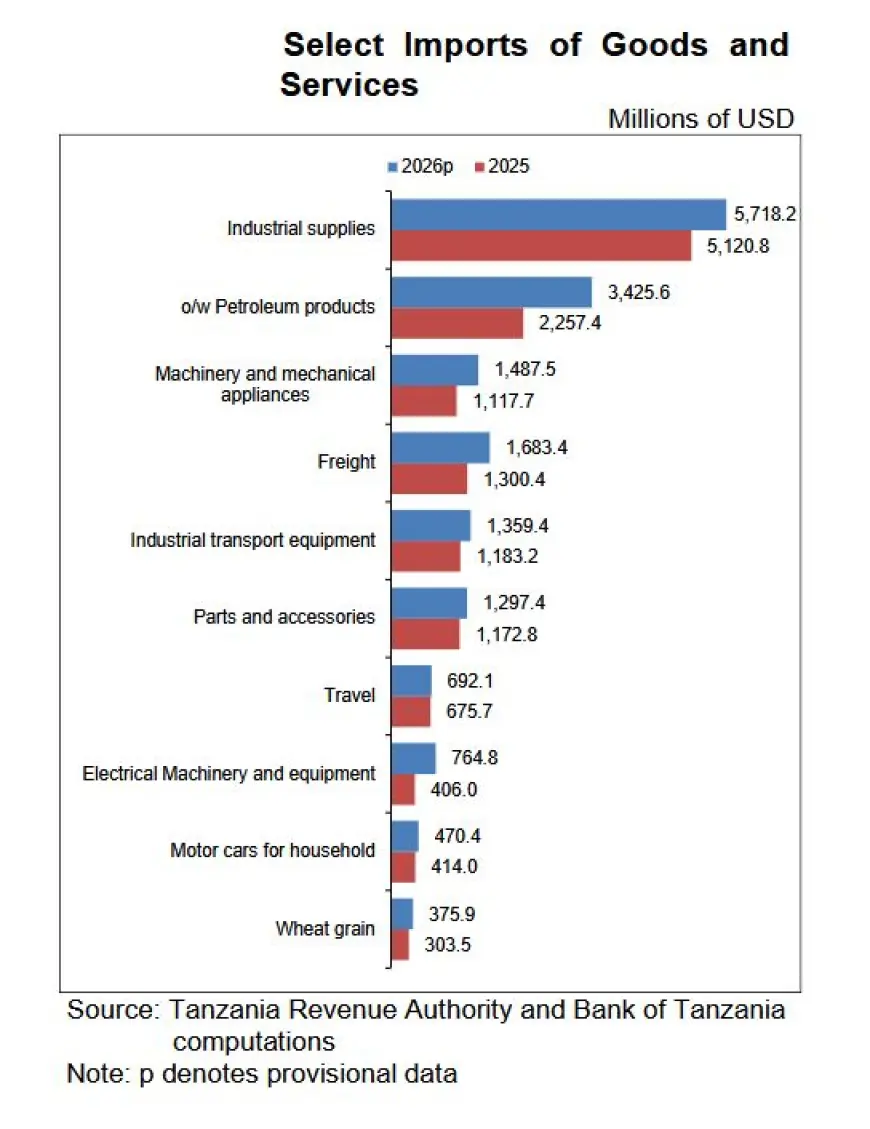
According to the BoT in August 2026 imports of goods and services increased by 21.4 percent to $21.27 billion in the year ending August 2026, outpacing export growth.
Petroleum products were a major contributor to the increase, with import expenditure rising by 51.7 percent to $3.43 billion from $2.26 billion.
The increase reflected higher global oil prices, while the conflict in the Middle East contributed to elevated shipping costs and freight payments.
Despite these external pressures, the expansion in exports points to stronger foreign exchange earnings from several sectors of the economy.
The challenge ahead will be to sustain the momentum in goods and services, deepen the contribution of manufactured products and strengthen the resilience of export earnings against fluctuations in global commodity prices and geopolitical developments.
What's Your Reaction?
 Like
0
Like
0
 Dislike
0
Dislike
0
 Love
0
Love
0
 Funny
0
Funny
0
 Angry
0
Angry
0
 Sad
0
Sad
0
 Wow
1
Wow
1