












































































African start-up funding passes $2bn mark following strong summer surge
Industry projections suggest total funding for 2026 could approach $3 billion, signalling a gradual recovery from the post-pandemic valuation adjustments that weakened venture capital markets globally


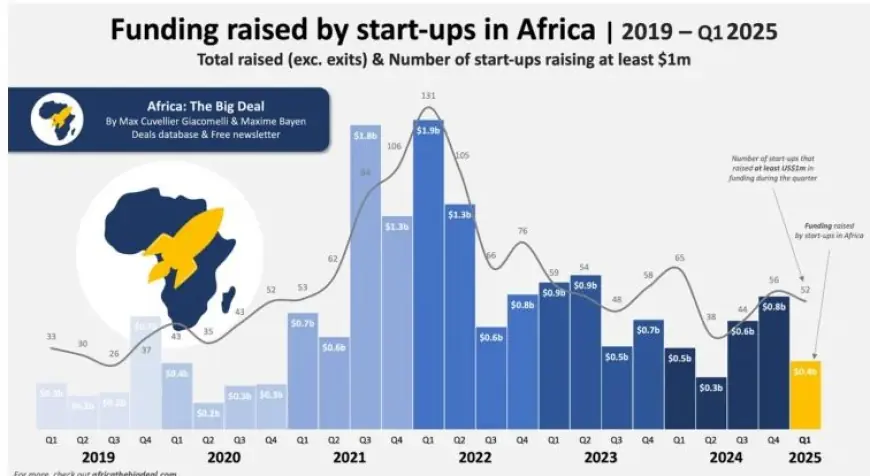
Dar es Salaam. Venture capital investment across Africa has officially crossed the $2 billion threshold in 2026, excluding exit transactions, following a sustained period of capital deployment through the summer months.
According to data compiled by industry tracker Africa: The Big Deal, the milestone was breached during the third week of September, pointing to a stabilisation in the continent’s technology investment market after several years of volatility.
While September's investment figures are unlikely to eclipse the exceptional totals recorded in June ($515 million) and August ($455 million), barring an unforeseen late-stage mega deal, the broader trend suggests that Africa’s start-up ecosystem is settling into a more measured recovery.
Reaching the $2 billion landmark in September puts the continent slightly behind the pace recorded in 2023 and 2025, when the threshold was crossed in August, but well ahead of 2024, when it was not reached until December.
Industry projections suggest total funding for 2026 could approach $3 billion, signalling a gradual recovery from the post-pandemic valuation adjustments that weakened venture capital markets globally.

The resurgence has also been visible beyond Africa’s traditional technology powerhouses.
Tanzania, for example, attracted $52 million in start-up funding between January and June 2026, making it one of the continent’s five largest funding destinations during the first half of the year.
The figure was almost equal to the $53 million raised by Tanzanian start-ups during the whole of 2024 and represented a sharp recovery from less than $20 million raised in 2025.
The Tanzanian performance is particularly notable because the country has historically attracted substantially less venture capital than Nigeria, Egypt, Kenya and South Africa.
The first-half performance raised expectations that Tanzania could record its first $100 million funding year if the momentum is maintained through December.
Across the continent, however, the recovery remains highly concentrated.
August was particularly strong, with 31 start-ups securing funding rounds of $100,000 or more.
The combined monthly total of $455 million represented a dramatic recovery from July’s $102 million and was more than double the previous 12-month rolling average of about $220 million.
The headline figure, however, masks a narrowing venture landscape.
The five largest transactions accounted for 84 percent of all capital raised in August.
Mobility Company Moove led the market with a $250 million Series C round, representing about 55 percent of the month's total funding.
Jumia secured $50 million in equity, crypto exchange Yellow Card raised $40 million, South African fintech platform Moment collected $22 million, while Egyptian buy-now-pay-later company ValU completed a $21 million corporate bond issuance.
Geographic concentration was equally pronounced. Nigeria, Egypt, Kenya and South Africa captured 99.5 percent of the capital invested in August and accounted for 29 of the 31 recorded deals.
Nigeria alone attracted $364 million, equivalent to about 80 percent of the month's funding.
Tanzania's emergence among the leading destinations during the first half of the year therefore offers an important indication that capital is beginning to reach markets outside the traditional Big Four, although the concentration seen at continental level remains substantial.
Deal volumes nevertheless show that significant challenges remain.
The 31 deals recorded in August were comfortably below the 12-month average of 43 deals a month, suggesting that the recovery is being driven more by larger transactions than by a broad expansion in the number of companies receiving investment.
For the first eight months of 2026, total African start-up funding reached $1.92 billion, about 9 percent below the equivalent period in 2025.
Equity financing has proved particularly resilient, increasing 23 percent year-on-year to $1.35 billion, helped substantially by mega-rounds involving Spiro and Moove.
Yet the number of companies benefiting from the recovery has fallen.
Year-to-date figures show that 269 unique ventures have completed rounds of $100,000 or more, a 19 percent decline from the 332 companies that raised capital during the corresponding period in 2025.
The investor pool has also contracted, with the number of active named investors participating in African technology deals falling 22 percent, from 368 to 288.
For Tanzania, the challenge will be to turn its strong first-half performance into sustained investment rather than a one-year surge.
Industry stakeholders have previously identified limited access to early- and growth-stage capital as one of the principal constraints facing local start-ups, prompting discussions around a proposed $50 million Tanzania Venture Capital Fund structured as a fund-of-funds.
Mergers and acquisitions continue to provide another liquidity route for established companies.
August recorded two significant exits, with Egyptian fintech Tamweely acquired by eFinance Group for $95 million, while Kenya-based Cloud9 acquired conversational commerce platform Chpter for an undisclosed sum.
The transactions brought the total number of recorded start-up exits across Africa to 30 in 2026.
The broader picture is therefore one of recovery, but not yet a return to the exuberance of the technology investment boom.
Capital is flowing again, yet it is increasingly being channelled towards larger, more established businesses and a relatively small number of markets.
For emerging ecosystems such as Tanzania, the opportunity lies in converting the renewed investor interest into a deeper pipeline of investment-ready businesses capable of attracting capital beyond the occasional large transaction.
What's Your Reaction?
 Like
0
Like
0
 Dislike
0
Dislike
0
 Love
0
Love
0
 Funny
0
Funny
0
 Angry
0
Angry
0
 Sad
0
Sad
0
 Wow
0
Wow
0