













































































Tanzania’s foreign exchange reserves climb to $5.5bn amid global market turbulences
The central bank's Monthly Economic Review attributes this substantial build-up to the resilience of the nation's external buffers during a period of heightened global economic uncertainty

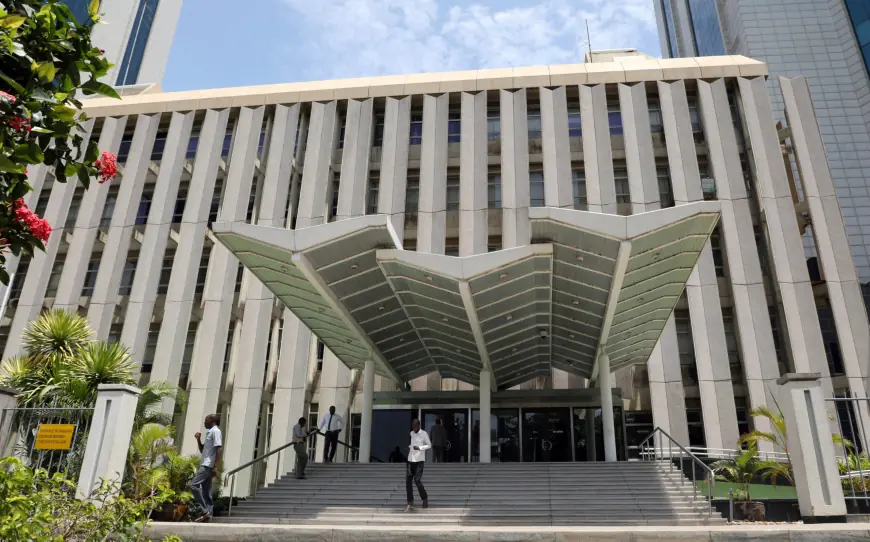
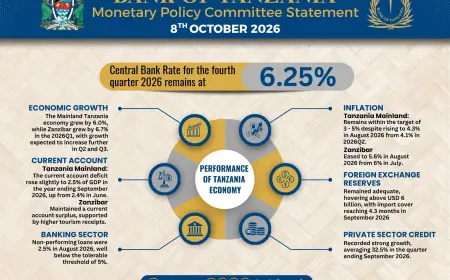
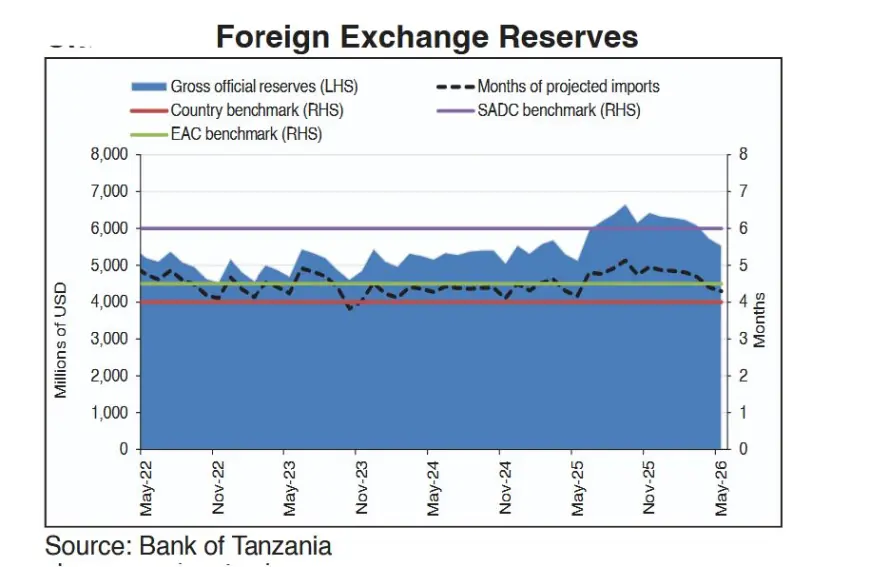
Dar es Salaam. Tanzania’s foreign exchange reserves rose to $5,538.8 million at the end of May 2026, representing a significant increase from the $5,136.7 million recorded during the corresponding period in the previous year, according to the latest official figures released by the Bank of Tanzania.
The central bank's Monthly Economic Review attributes this substantial build-up to the resilience of the nation's external buffers during a period of heightened global economic uncertainty.
The positive trajectory has been heavily underpinned by robust export receipts, driven primarily by gold transactions, alongside the successful execution of the national domestic gold purchasing programme.
At their current level, the accumulated reserves are sufficient to cover approximately 4.3 months of projected imports of goods and services.
This coverage remains comfortably above Tanzania’s national adequacy threshold, signalising robust macro-financial stability and structural capacity to withstand external balance of payments shocks.
The reserve stock successfully exceeds almost all regional policy benchmarks.
This includes the country's own domestic targets as well as the convergence criteria established by the East African Community.
However, the stockpile remains slightly below the more stringent requirements prescribed by the Southern African Development Community convergence benchmarks.
Despite the expansion of these monetary cushions, the central bank noted that the broader external sector has remained under considerable pressure over the twelve months leading to May 2026.

The challenges reflect the ongoing spillovers of intense geopolitical tensions, which have repeatedly disrupted international commodity markets and global maritime shipping networks.
These disruptions contributed to a widening of the current account deficit, which grew to $2,209.5 million from the $2,090.9 million reported in the preceding year.
This expansion in the deficit was driven by the import bill for goods and services outstripping export growth, fuelled by elevated freight logistics costs and digitally elevated global commodity prices.
What's Your Reaction?
 Like
0
Like
0
 Dislike
0
Dislike
0
 Love
0
Love
0
 Funny
0
Funny
0
 Angry
0
Angry
0
 Sad
0
Sad
0
 Wow
0
Wow
0