







































































Shilling slips marginally in a week of heavier dollar demand

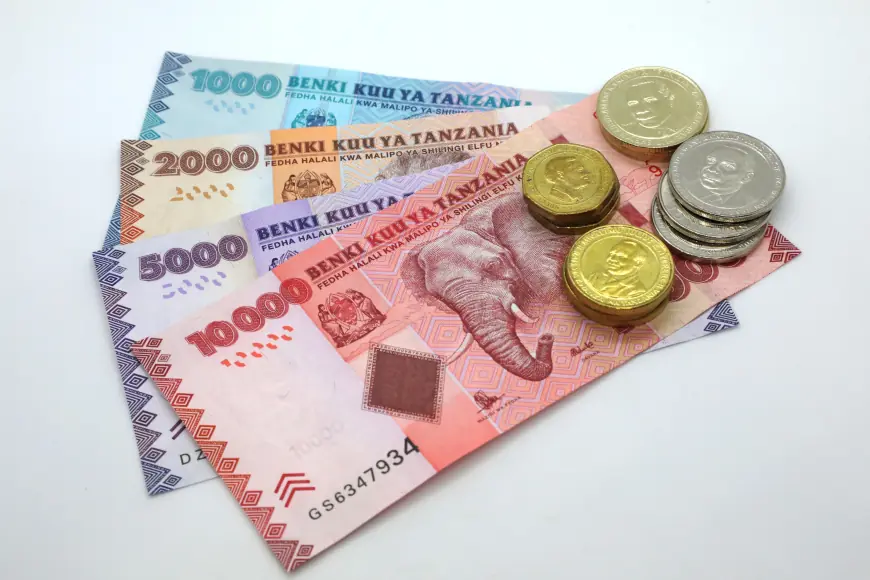
Dar es Salaam. The Tanzanian shilling ended last week slightly weaker against the US dollar, but remained broadly stable, a Bank of Tanzania (BoT) review shows.
Retail foreign exchange activity rose sharply while interbank trading slowed, according to the Bank of Tanzania's weekly markets report.
The shilling closed the week ending October 30, 2026 at Sh2,640.73 to the dollar, from Sh2,636.74 a week earlier.
That is a depreciation of about 0.15 percent, or roughly four shillings. The move is modest by any standard and leaves the currency range-bound.
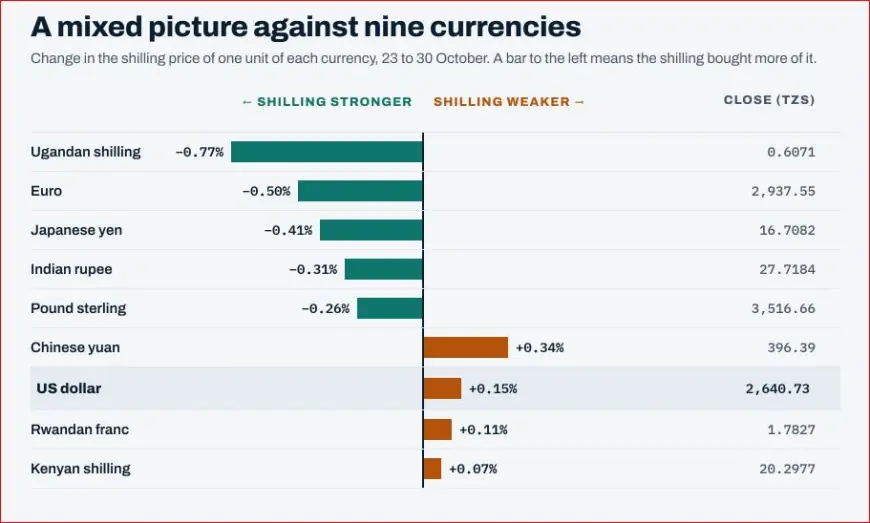
Mixed picture against other currencies
The shilling's performance varied across the major trading currencies.
It gained against sterling, which fell 0.26 percent to Sh3,516.66, and against the euro, which eased 0.50 percent to Sh2,937.55.
It also strengthened against the Japanese yen (down 0.41%), the Indian rupee (down 0.31%) and the Ugandan shilling, which fell 0.77 percent to Sh0.6071.
The local unit lost marginal ground against the Chinese yuan, which rose 0.34 percent to Sh396.39.
It also weakened slightly against the Kenyan shilling, up 0.07 percent to Sh20.2977, and the Rwandan franc, up 0.11 percent to Sh1.7827.
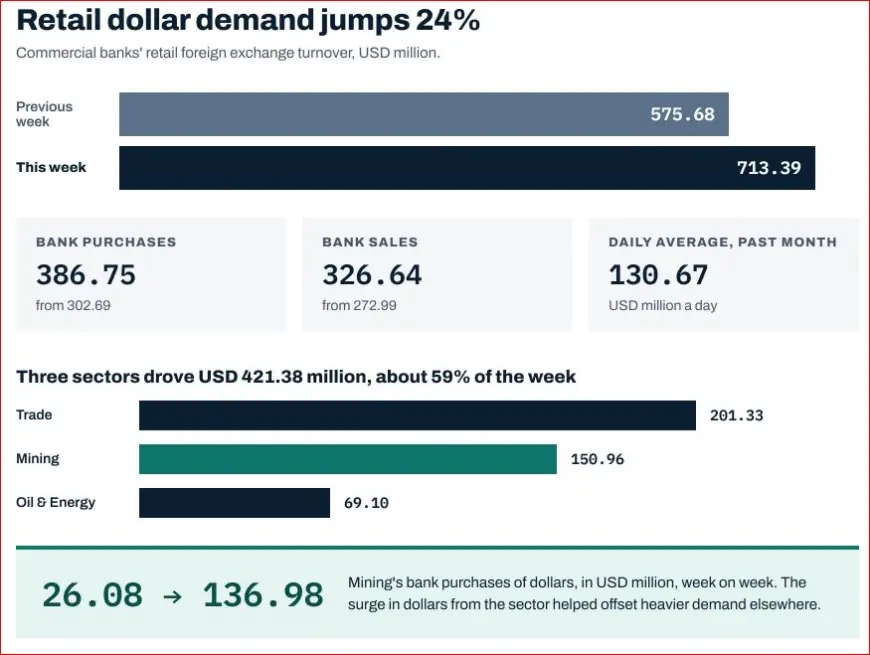
Retail dollar demand jumps
The most striking development was in the retail market.
Commercial banks' retail foreign exchange transactions rose to $713.39 million from $575.68 million the previous week, an increase of about 24 percent.
Bank purchases rose to $386.75 million, while sales climbed to $326.64 million.
Trade accounted for the largest share of turnover at $201.33 million, followed by mining at $150.96 million and oil and energy at $69.10 million.
Together, these three sectors made up $421.38 million of the weekly total.
Mining was the notable mover. Its bank purchases, which broadly reflect dollars sold by customers, jumped to $136.98 million from $26.08 million a week earlier.
That inflow of dollars appears to have helped offset heavier demand from importers and other sectors.
Over the past month, daily retail turnover has averaged $130.67 million.
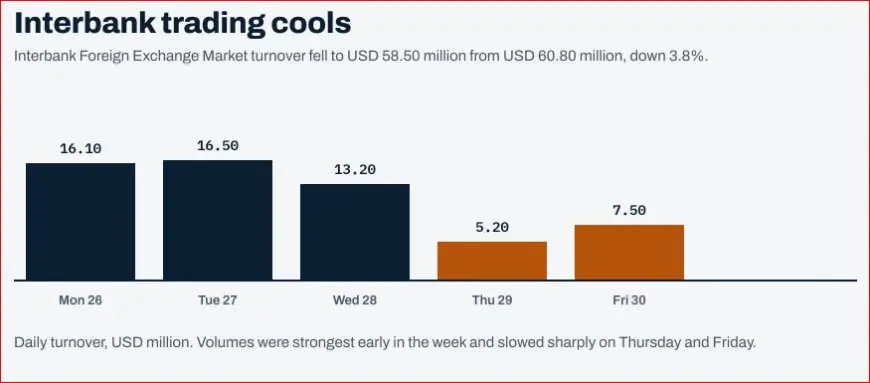
Interbank trading cools
Activity on the Interbank Foreign Exchange Market eased to $58.50 million from $60.80 million.
Volumes were strongest early in the week, at $16.10 million on Monday and $16.50 million on Tuesday, before slowing to $5.20 million on Thursday and $7.50 million on Friday.
Money market conditions stay anchored
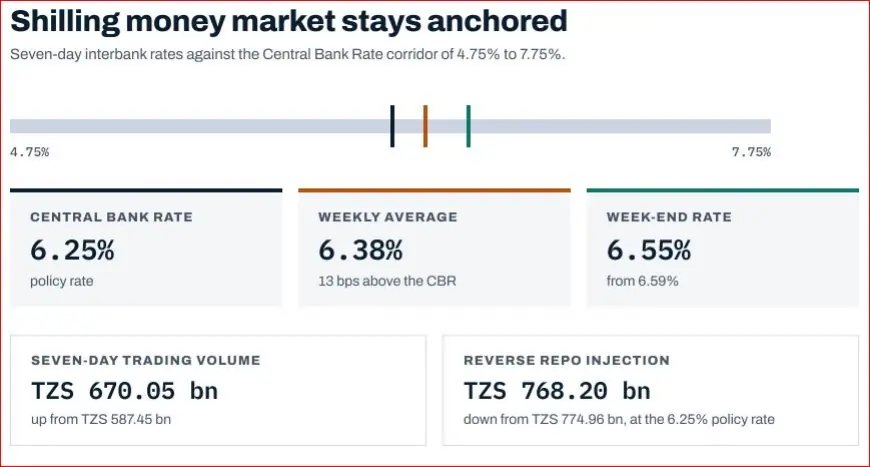
In the shilling money market, the seven-day interbank cash market weighted average rate closed the week at 6.55 percent, down from 6.59 percent.
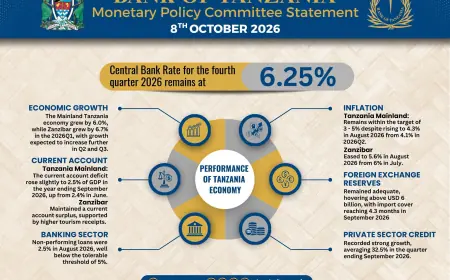
The weekly average of 6.38 percent sat 13 basis points above the Central Bank Rate of 6.25 percent and comfortably within the 4.75 percent to 7.75 percent corridor. Trading volume rose to Sh670.05 billion from Sh587.45 billion.
The central bank injected Sh768.20 billion through seven-day reverse repurchase operations at the policy rate, slightly less than the Sh774.96 billion the week before.
Bond demand pushes yields lower
Strong appetite for government paper may offer further support to sentiment.
A 20-year Treasury bond auctioned on 28 October drew bids of Sh1,033.09 billion against Sh363.01 billion on offer, a bid-to-cover ratio of 2.85 times.
The weighted average yield to maturity fell to 10.5214 percent, from 11.3306 percent at the previous auction of the same tenor, and Sh336.62 billion was allotted.
Outstanding government securities stand at Sh34,474.24 billion, of which Treasury bonds make up 89.43 percent. Banks hold 34.28 percent of the total and pension funds 29.70 percent.
Market attention now turns to the next auction, on Wednesday 4 November, when a two-year Treasury bond will be offered.
Participants will also watch whether the surge in retail dollar demand persists and whether mining inflows continue to cushion the shilling.
What's Your Reaction?
 Like
0
 Dislike
0
 Love
0
 Funny
0
 Angry
0
 Sad
0
 Wow
0