

















































Dar es Salaam Stock Market regains momentum after post-election disruptions
Data from the exchange show that total equity turnover rose sharply to Sh5.10 billion, compared with Sh3.75 billion during the shortened trading week that ended on October 30

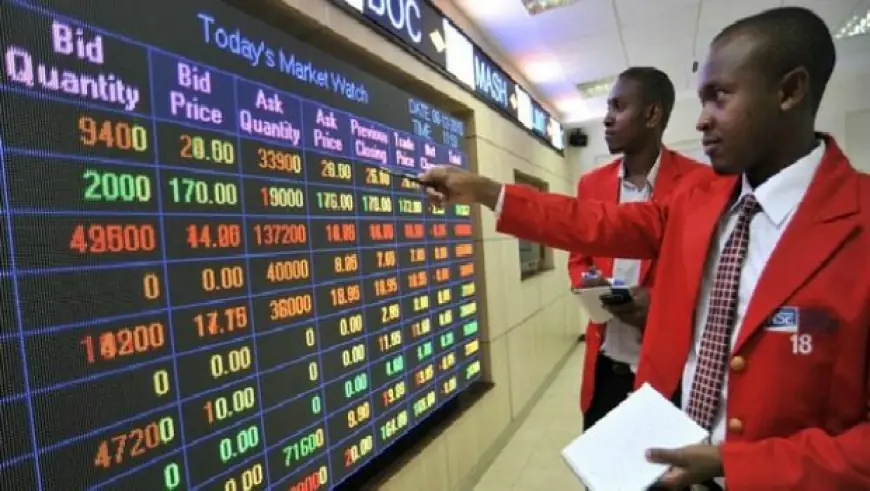
Dar es Salaam. The Dar es Salaam Stock Exchange (DSE) showed encouraging signs of recovery last week as trading resumed in full following temporary disruptions caused by post-election unrest and a nationwide internet shutdown.
Despite mild declines in major indices, the market recorded stronger liquidity, rising turnover, and improved investor engagement — developments seen by analysts as a signal of resilience and growing confidence in Tanzania’s capital markets.
The DSE reopened for a full trading week on Tuesday, November 4, 2025, after remaining closed for four trading days in the wake of the October 29 General Election.
Data from the exchange show that total equity turnover rose sharply to Sh5.10 billion, compared with Sh3.75 billion during the shortened trading week that ended on October 30.
The number of transactions also increased from 512 deals in Week 44 to 836 deals in Week 45, indicating that trading operations were steadily returning to normal despite the volatile political atmosphere.
The overall market capitalisation stood at Sh16,425.30 billion, a marginal decline of 0.96 percent, while the Domestic Market Capitalisation closed at Sh13,574.52 billion, down by 1.76 percent.
Market adjustment, not weakness
Analysts, however, described these movements as expected market adjustments following a trading suspension rather than signs of sustained weakness.
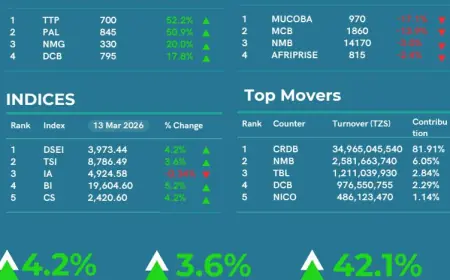
The All Share Index (DSEI) ended the week at 2,506.34 points, lower by 1.06 percent from 2,533.20 points recorded on October 30.
The Tanzania Share Index (TSI), which tracks locally listed firms, closed at 5,127.78 points, reflecting a 1.67 percent contraction.
Market experts said that despite these declines, the narrowing of losses towards the end of the week demonstrated stabilising sentiment among both domestic and foreign investors.
In sectoral performance, the Commercial Services Index fell to 2,428.17 points, down by 2.69 percent, while the Banks, Finance and Investment Index eased to 4,182.33 points, a dip of 1.75 percent.
The Industrial and Allied Index also declined by 1.23 percent to settle at 6,090.44 points.

Analysts noted that these mild contractions were largely offset by stronger trading activity and the resilience of several counters that attracted renewed buying interest.
Among the top performers, MKCB continued its upward trajectory, climbing by 10.71 percent to close the week at Sh620 per share, while PAL gained 6.45 percent to end at Sh2,310.
The sustained rally in these counters reflected investor confidence in firms with strong fundamentals and steady dividend histories.
Although some leading banks posted modest corrections, their trading volumes remained robust. CRDB Bank Plc, for instance, saw its price ease by 4.10 percent to S1,170, but retained the highest liquidity on the exchange, accounting for 31 percent of total weekly turnover.
DCB Commercial Bank Plc fell by 5.36 percent to Sh265, while NMB Bank Plc shares remained stable at Sh4,000, reflecting sustained institutional demand.
The exchange’s own shares, DSE Plc, ended the week at Sh6,240, representing a 6.87 percent adjustment.
Market participants viewed this as a temporary response to overall market sentiment rather than a reflection of the exchange’s operational performance.
Fixed-income segment
Meanwhile, activity in the fixed-income segment remained healthy despite a decline in turnover.
Total bond turnover stood at Sh52.59 billion, compared with Sh82.86 billion in Week 44.
Government securities continued to dominate the market, accounting for more than 96 percent of the week’s transactions.
The most notable deal involved a Sh25 billion trade in the 25-year Treasury bond, highlighting investor preference for long-term instruments even amid political uncertainty.
Analysts observed that the participation of pension funds, insurance companies, and asset managers in the bond market was a key stabilising factor, providing liquidity and ensuring confidence in Tanzania’s financial system.
The yield curve for medium and long-term government securities remained largely unchanged, suggesting that major institutional investors were adopting a calm, long-term view of the economy.
Economists said that the swift resumption of normal trading, the increase in turnover, and the steady performance of select counters underscored the underlying strength of the Tanzanian market.
They added that such resilience was an encouraging sign for both local and foreign investors, particularly given the challenges of the preceding week.
The DSE’s ability to rebound after a period of disruption has been attributed to ongoing capital market reforms, improvements in regulatory oversight, and the growing participation of institutional investors.
The exchange’s automation systems and the Central Depository platform functioned seamlessly after the restoration of internet services, enabling smooth settlements and trade confirmations.
Reactions
Market analysts expect the positive momentum to continue into the coming weeks as political conditions stabilise and macroeconomic indicators improve.
The gradual recovery in turnover and steady investor participation are expected to support a rebound in key indices before the end of November.
While uncertainties remain, particularly around political reconciliation efforts, the outlook for the DSE remains cautiously optimistic.
With a total market capitalisation exceeding Sh16 trillion, increasing investor sophistication, and expanding product diversity, Tanzania’s stock market continues to demonstrate its resilience and potential as a key driver of long-term capital formation.
What's Your Reaction?
 Like
0
Like
0
 Dislike
0
Dislike
0
 Love
0
Love
0
 Funny
0
Funny
0
 Angry
0
Angry
0
 Sad
0
Sad
0
 Wow
0
Wow
0