








































































National debt tops Sh110trn as CAG submits Audit reports to Samia
The reports, submitted at State House, show that Tanzania’s public debt reached Sh110.05 trillion as of June 30, 2025

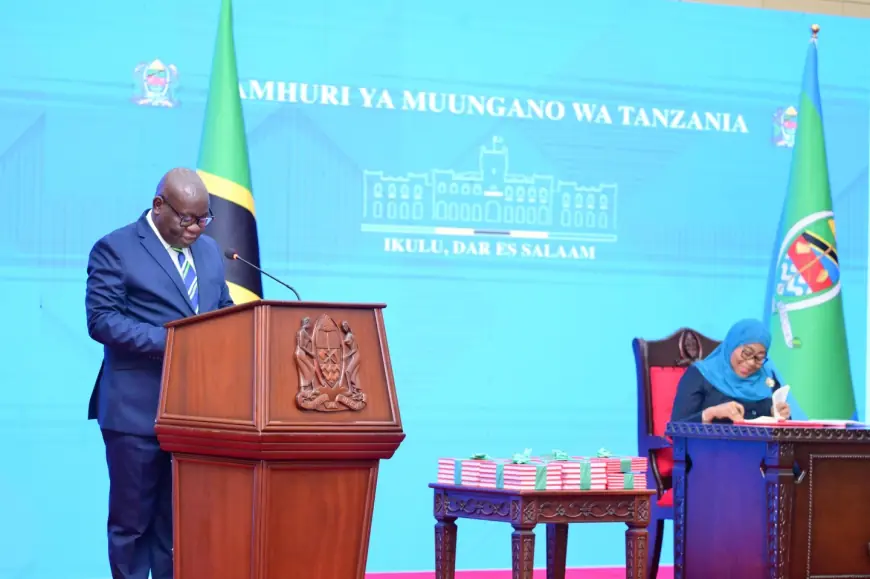
Dar es Salaam. The Controller and Auditor General (CAG) on Monday, March 30, 2026, presented his annual audit reports to President Samia Suluhu Hassan, placing renewed focus on the country’s rising national debt and broader fiscal pressures.
The reports, submitted at State House, show that Tanzania’s public debt reached Sh110.05 trillion as of June 30, 2025.
This marks an increase of Sh12.7 trillion, equivalent to 13 percent, within a single year.
According to the CAG, the debt stock comprises both domestic and external obligations.
Domestic debt stood at about Sh35.5 trillion, while external debt accounted for roughly Sh74.55 trillion.
The figures underline the growing reliance on external borrowing to finance development expenditure and budgetary needs.
The latest audit findings indicate that the pace of debt accumulation remains significant.
The increase reflects continued government borrowing to support infrastructure projects and other priority sectors.
However, it also raises concerns about long-term sustainability and fiscal discipline.
The presentation of the reports follows constitutional requirements that mandate the CAG to submit audited accounts of public finances to the Head of State.
The office, operating under the National Audit Office, plays a central role in scrutinising government expenditure and ensuring accountability in the use of public resources.
While the reports cover a wide range of public entities and financial operations, the sharp rise in national debt stands out as a key issue.
It signals mounting obligations that could exert pressure on future budgets, particularly in debt servicing costs.

Comparative data shows a steady upward trend. In the previous financial year, ending June 2024, national debt stood at about Sh97.35 trillion.
The latest figures therefore confirm a continued expansion of the debt burden over successive years.
The CAG noted that external borrowing remains the primary driver of the increase.
This reflects the government’s strategy of financing large-scale development projects through concessional and commercial loans from abroad.
Despite the rise, previous assessments have indicated that Tanzania’s debt remains within sustainable thresholds based on key macroeconomic indicators.
Nonetheless, the new figures are likely to intensify scrutiny from policymakers, economists and the public.
The reports are expected to be tabled in Parliament in the coming days.
Legislators will debate the findings and may propose measures to strengthen public finance management and debt oversight.
The presentation comes at a time when public concern over fiscal accountability is growing.
Audit reports have increasingly highlighted inefficiencies, financial losses and weaknesses in some public institutions.
As attention shifts to Parliament, the latest findings are set to fuel debate on how Tanzania can balance its development ambitions with prudent debt management.
What's Your Reaction?
 Like
0
Like
0
 Dislike
0
Dislike
0
 Love
0
Love
0
 Funny
0
Funny
0
 Angry
0
Angry
0
 Sad
0
Sad
0
 Wow
0
Wow
0